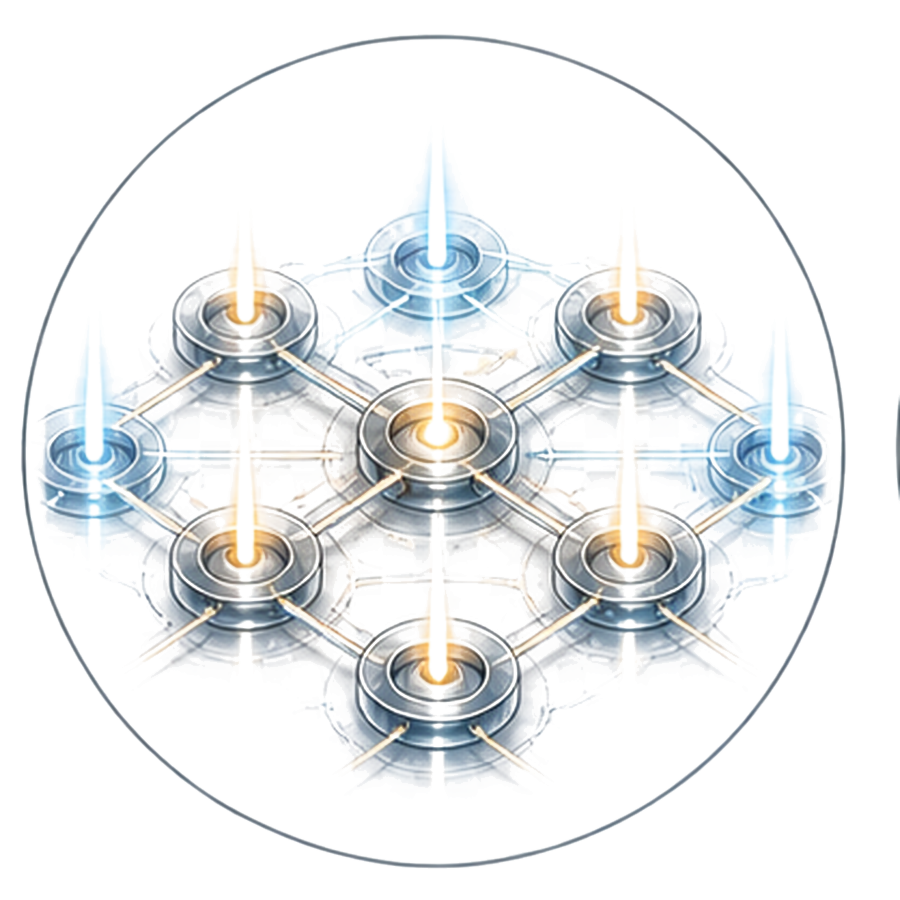
Recent results connect device physics with computing systems: programmable nonlinear photonics and multimode waveguides, optical neural networks operating with very few photons, and all-optical recurrent processing at high clock rates.
Optimization research links geometric explanations of coherent Ising machine dynamics with probabilistic Ising processors, wireless signal detection, and methods for extending quantum optimization to polynomial objectives.
Operational benchmarking accounts for the cost of parameter tuning and the full solution workflow. The collaboration also includes research on representation and bias in computing, alongside education and internship activities. The publication archive and dated news provide sources for these research directions.
fundamentals
Fundamentals
Physical dynamics beyond conventional digital electronics as foundations for hard optimization.
What performance advantages can unconventional approaches offer, and what obstacles must be overcome to realize them? Do unconventional models of computing enable new analyses of why some optimization instances are much harder than others?
generalizations
Generalizations
Coherent Ising Machines as a reference architecture for broader coherent network computing.
The project studies operational bottlenecks of canonical CIMs and generalizations for non-binary variables, higher-than-quadratic cost functions, constraints, and potential quantum advantages.
applications
Applications
Practical uses of CIMs and related architectures for real-world optimization.
The team studies how real-world problems map into binary quadratic optimization frameworks, what overheads are incurred, and which generalizations could unlock important applications.
benchmarking
Benchmarking
Principled comparisons among unconventional, quantum, and conventional optimization approaches.
Benchmarking work focuses on scaling definitions, heuristic complementarity, testbeds, and statistically meaningful performance comparisons.
participation
Broadening Participation in Computing
Education and participation studies connected to computer science identity and persistence.
The project partners with education and outreach collaborators to study factors affecting computer science identity and career-track persistence among students from historically minoritized backgrounds.